Attend the 25th Cairo ICT Event

Fast approaching!

The 25th Cairo ICT Event is set to hold at the Egypt International Exhibition Center, New Cairo from Nov 15-18, 2021 with the slogan "The Digital Challenge". Kindly register now​ and mark your calendar for an adequate plan to attend.

What makes Cairo ICT unique is her magical blend of technologies, industries, audience, spearheaded with a far-sighted vision about what is needed in the Middle East & Africa. Cairo ICT is the Tech event that serves national objectives, businesses, development, and human resources.

Please find the attached document for further information.

AfICTA-WAIGF Workshop 2021

AfICTA - West African IGF 2021 Workshop Session
28-30 July 2021
Virtual

Session/Event:

Digital Inclusivity in West African Countries (WACs): Exploring User Connectivity vs. Content

Date:

29 July 2021

Time:

1:00 - 2:00 pm GMT

Moderator:

Mr. Inye Kemabonta / AfICTA- Africa ICT Alliance

Reported By:

Oyeyemi Kayode Isaiah / AfICTA - Africa ICT Alliance


Panelists:

Dr. Kossi AMESSINOU (Government)

Mr. Eric Kouam (Private Sector)

Summary of the Presentations:

The session was opened by the Chair of AfICTA, Mr. Thabo Mashegoane, who graciously joined from Johannesburg in South Africa with opening remarks and appreciation to the WAIGF organizing team for giving AfICTA the platform to discuss such a very important topic and without delay, the moderator, Mr. Inye Kemabonta yielded the platform to the panellists for a brief introduction, after which the panellists took turns to address the policy questions.

Policy Question 1

Given the fact that a user-centric policy formulation approach is proven to be more efficient, How do we mobilize policymakers and users to take ownership of policy formulation from the perspective of their own needs?

Eric Kouam:

The session began with Eric Kouam who spoke expressly on the first policy question. He defined a “user-centric policy formulation approach” as one that is intentionally designed and implemented with the end-user group as a co-designer. He defined users as those who; use a product or service, benefit from its usage, or are imparted by the policy behind it.

He categorized the policy formulation process into two stages which include “1. Clear Assessment, and 2. Implementation, The Clear Assessment stage is the stage at which the approach to adopt for policy formulation is defined. He emphasized the need to ensure the approach is clear enough to accommodate the views and metrics of all relevant stakeholders involved. Furthermore, Eric Kouam defined, Implementation stage as the stage where the policy formulated is put into effect.

One of his recommendations was that the Civil Society Organizations should undertake education and enlightenment programs to sensitize stakeholders who are normally impacted by policies, and Governments Agencies involved in policy development (such as NITDA in Nigeria and NITA in Ghana) about the critical importance of inclusiveness to eventual and meaningful policy implementation.

Dr. Kossi Amessinou:

Dr. Kossi Amessinou’s opinion about the above policy question was that “although there may be the need for deeper involvement of individual citizens/users in policy formulation, but users have always been participating in the process. He added that civil society should be specific about the issues they would like to handle or address and not just a “jack of all trades, master of none”. He advised that there may be a need for users to identify with any relevant civil society group to form a stronger voice that enforces their recommendations into consideration.

Other recommendations included:

  1. Associations such as AfICTA, which represent private businesses and stakeholders in general, should engage in strong advocacy programs to encourage Governments to ensure that templates for policy formulation would always be clear for users to identify with and allow inclusiveness, both at the assessment and implementation stages. In that regard, Government should be regularly prompted by such representative bodies to adopt a bottom-up approach to policy development.

  2. Users and stakeholders should be sensitized on the need to identify with relevant civil society or organizations such AfICTA - Africa ICT Alliance, A4AI - Alliance for Affordable Internet and African ICT Foundation through which their voices could be strongly heard.

After a 10 minutes interaction with the participants, the second part of the session started and the speakers addressed the second policy question as found below:

Policy Question 2

What innovative and emerging practices can be implemented to stimulate the demand/consumption of indigenous digital services and solutions?

Dr. Kossi Amessinou expressed how dissatisfying Internet service which is the major driver for digital services and solutions could be and hence recommended that there should be more investment into internet infrastructure and maximum usage of the available submarine cables. He added that the cost of broadband should be relatively low to allow more people to access citizen-facing services online.

Eric Kouam’s opinion was that governments of WACs should digitize their processes and records without any further delays and put citizen-facing services online while also ensuring that digital infrastructure deficits are vigorously addressed.

One of the interactions from among the attendees was that government should create a level playing field and provide some level of support to local content creators to ensure they meet the standards generally acceptable by users at an affordable price.

Key Issues Raised:

  1. “Given the fact that a user-centric policy formulation approach is proven to be more efficient, How do we mobilize policymakers and users to take ownership of policy formulation from the perspective of their own needs?
  2. “What innovative and emerging practices can be implemented to stimulate the demand/consumption of indigenous digital services and solutions?”
     

Actions recommended:

  • Users and stakeholders should be sensitized on the need to identify with relevant civil society or organizations such as AfICTA - Africa ICT Alliance, A4AI - Alliance for Affordable Internet and African ICT Foundation through which their voices could be strongly heard. (It’s an ongoing effort by AfICTA, A4AI…)

  • Associations such as AfICTA, which represent private businesses and stakeholders in general, should engage in strong advocacy programs to encourage Governments to ensure that templates for policy formulation would always be clear for users to identify with and allow inclusiveness, both at the assessment and implementation stages. In that regard, Government should be regularly prompted by such representative bodies to adopt a bottom-up approach to policy development. (It’s an ongoing effort by AfICTAwith aim to intensify before the end of 2021)

  • Civil Society Organizations should undertake education and enlightenment programs to sensitize stakeholders who are normally impacted by policies, and Governments Agencies involved in policy development (such as NITDA) about the critical importance of inclusiveness to eventual and meaningful policy implementation. (Civil Societies)

  • Eric Kouam’s opinion was that governments of WACsshould digitize their processes and records without any more delays and put citizen-facing services online while also ensuring that digital infrastructure deficits are vigorously addressed. (Action by WACs Government and according to the SDGs, sooner than 2030)

  • Among the interactions from the participants includes a recommendation that WACs Government should create a level playing field and provide some level of support to local content creators to ensure they meet the standards generally acceptable by users at an affordable price. (Action by WACs Government)

Other Discussion Points:

  • Demand drivers for digital services and solutions were examined and aside from the need for government to invest heavily into Internet infrastructures, the opinion that WACs government should ensure it digitized the services they offer the general public was also raised and by so doing citizens would be driven to go online. We may be doing well when it comes to the Finance sector, eCommerce, e-Transportation, e-Agriculture but more importantly Health sector, Education Sector etc. should as well be digitized.


  • A participant raised the concern on how Government provided services are extremely monopolistic and it becomes so difficult for consumers and users to demand better quality of service when there are no better alternatives to switch to. An example given was that “Government-run web-servers are usually unstable but government-owned websites are not allowed to be hosted on private-owned web servers. Eric Kouam responded that Government has the responsibility to ensure they offer acceptable service to the users but users need to make a demand for such through awareness, advocacy, and constructive engagement.

  • Most of the time our African governments restrict access to the Internet due to security reasons. There are many countries where the Internet was disconnected during election polling. Nigeria recently passed a restriction on access to Twitter. The logic behind promoting internet quality and simultaneously restricting its access is unfathomable.  Kossi Amessinou wants users to continue to create awareness of the impact restricting Internet access has on businesses and their survivability.

The moderator, Mr. Inye Kemabonta ended the session with a summary of all the points made and appreciation to the organizer of the 13th West Africa IGF, the panellist, the participants. 


Download this report in pdf

Register Now for the AfICTA's Session @ the West Africa IGF - 2021

The 2021 edition of the West African IGF holds from July 28th-30th and you are invited to register and join a session.

Theme: Digital Inclusivity in WACs: Exploring User Connectivity vs. Content
Date: 29th July 2021
Time: 1:00pm GMT

To have your unique meeting link, kindly register now.

See you there...

AfICTA Secretariat

Barka de Sallah!

At AfICTA-Africa ICT Alliance, when our arms cannot reach people close to our hearts, we always hug them with our prayers. As you celebrate Eid-el-Kabir, may Allah’s peace and blessings be with you & your family. Barka de Sallah!

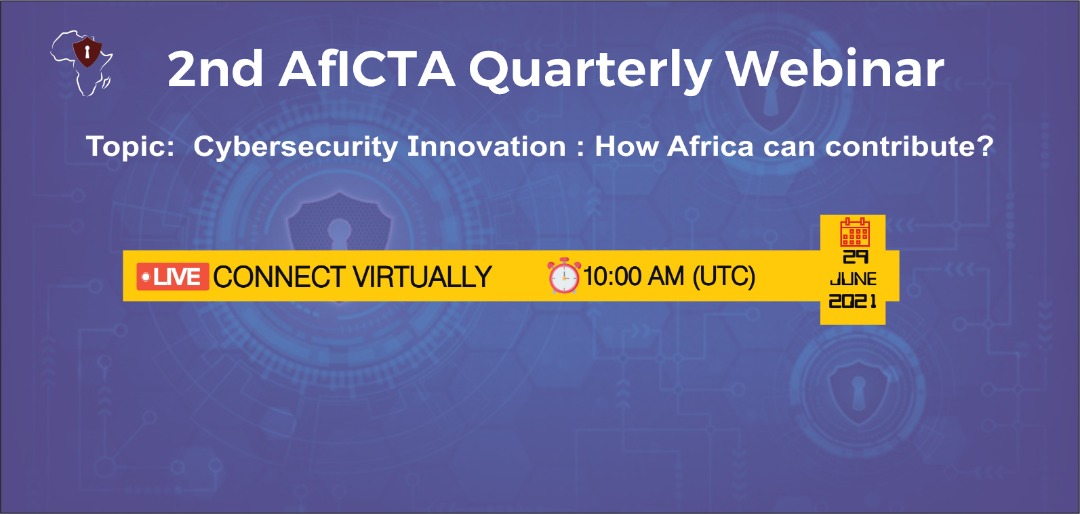
2nd AfICTA Quarterly Webinar 29 June 2021


The 2nd edition of the AfICTA Quarterly webinar was successfully organized on 29 June 2021. The event was hosted by the West African Region spearheaded by Mr. Tola Sogbesan. The session was channeled to company representatives and business owners in attendance and was moderated by Mr. Laicana Coulïbaly, Cybersecurity Expert; alongside himself were panelists: Cheick Omar OUEDRAOGO, Deputy General Manager of Talentys, Burkina Faso; Sidik TOUREProgram Director, Banking and Critical Services Security, Orange Middle East and Africa; Eloge BEONAO, CIO, MTN Côte d’Ivoire; Jean-Robert HOUNTOMEY, Director, AfricaCERT; Fabien NDIOMO, Regional Information Security Head WECA of MTN Group.


The theme of the session was Cybersecurity Innovation "Cybersecurity Innovation: How Africa Can Contribute." The webinar aimed at discussing Cybersecurity Innovation in Africa, the state of consumption of cyber solutions and standards, what needs to be done for Africa to become major contributors, the responsibilities of public and private sectors, the necessity for Digital Sovereignty, and the need for innovative indigenous solutions and standards, based on our realities. The expected outcome was to develop recommendations for both the public and private sector on clear actions and plans to be implemented across the Continent that can engender Cybersecurity capacity development and Cyber Innovation.

In the opening session, Mr. Thabo Mashegoane, opened by thanking the panelists for their time and expertise, welcomed the participants, and proceeded to buttress the importance of the theme of the webinar which is very imperative in the post COVID world which saw exponential growth in the Cyber threats due to the rapid Digital adoption in the new age. The spike in cyber threats not only creates a demand for cyberthreats solutions but also creates a market for cyber innovators and the theme of the webinar would focus on the Afrocentric approach to meeting the demands pertaining to the specific context of the African Cyber Ecosystemguest speaker

Mr. Laicana posed the first question on Africa's contribution currently to the global cyberspace ecosystem and Mr. Cheick Omar shared his opinions from the microscopic analysis of the francophone countries in Africa. Although the recent pandemic times have resulted in an increase in general digital adoption there isn't any significant interest nor contributions in the cybersecurity innovation because stakeholders still inherently hold user-centric views on the benefits of adoption. The best way to address this is through constant and sustained awareness at all levels to ensure there is increased interest in the field.

Cyberthreat agencies across the continent are either non-existent or dysfunctional and this needs to be addressed quickly albeit there is a lack of resources for this sector but the market created by the sector is very massive and could also be an avenue for job creation across the continent.

Jean-Robert from AfricaCERT held a more optimistic view that although more works need to be done on the continent in terms of developing solutions and strategies that aid mitigation of cyber threats they also need to be commended so far on the continent as more countries are now creating cybersecurity policy frameworks and in some cases capacity development schemes in the sector.

According to the research from AfricaCERT working rigorously to stimulate development through close efforts with the African Union and other National Agencies, ECOWAS now has developed a global Cybersecurity for all countries in the region of the West African states. As of last year, 21 Incident Response teams were set up in the continent and now there are about 27 which indicates the growing efforts in the area albeit there is still a need for more resources and capacity building within these agencies and organizations. African Nations are participating in the UNDG & UN Open-Ended Working Group discussion on Cybersecurity which means there is a growing appetite for application security, product security, and issues related to investigation availability and disclosure. The naming Industry has also made very significant strides through vertical collaboration across African Countries such as the Cyber drill exercises organized between CIR organizations and National partners.

There is a need for the public sector to create the guidelines and platforms that engender Cybersecurity innovation and solutions by ensuring all stakeholders in the digital economy ecosystem are held to specific security standards that are not to be bridged. In North Africa, policies that require regular assessment tests, notification, and reporting of incidences are established and implemented which shows that there is also a need for more vertical collaboration and sharing of best practices such as the aforementioned to engender cybersecurity awareness and growth in other parts of the continent. The major reason for the lack of implementation of these cybersecurity standards and policies is due to the lack of investment and resources provided in terms of expertise and capacity and investigative technologies. The private sector needs to priorities cybersecurity by providing norms through knowledge sharing on best practices.


Although there is a need for adaptation of global standards based on the socio-economic realities in Africa, global standards are available for certain reasons, primarily for more synergy. Notwithstanding, there is a need for cybersecurity frameworks based on the African context, but we must ensure that we don't deviate from the "global truth". We may create policies and standards that prioritize the African socio-economic realities, the collaboration between all stakeholder groups has to be implemented to ensure that these standards are understood by everyone involved. It may be more beneficial for African teams to join global standard-making bodies to ensure we contribute and table our needs at standard and policy discussions rather than desolidarizing by creating ours.

A major discussion at the European Union (EU) is the matter of digital sovereignty, the growing penetration of technology also indicates the need for digital sovereignty in Africa. it is clear that technology really reforms how people interact and this is exemplified with the boost in digital users in Africa. For us to begin to have control over the way our data is utilized, then we need to begin to think of how we can become creators and not just consumers of cyber technologies because so long as someone else creates for you then it is impossible to control or manage how your data is utilized. In other to migrate to being creators of cyber technology as opposed to just consumers, a mental shift from all stakeholder groups is imminent so matters of cybersecurity are prioritized as a matter of Security not just for cyberspace and the major step in this direction would entail creating budgetary allocation at all levels for Cyber solutions and technologies. 


Cyber capacity building as defined by the global forum for Global Forum on Cyber Expertise (GFCE) has 4 pillars:

  1.  Policy and Strategy: interested in National Strategy Assessment, Confidence building measure norm & Cyber diplomacy & international law in cyberspace.
  2.  Incident Management & Critical Infrastructure Protection: interested with National Computer emergence & Security Incidence Response teams, Cybersecurity exercise and Critical Information Protection. 
  3. Culture & Skills: interested in Cybersecurity assessment, Education, and Training & Workforce Development.
  4. Standard: interested in the promotion of internet-related standards. The GCFE works on having constant constructive dialogue among multi-stakeholder groups to set the agenda to drive Cybersecurity development. The public sector needs to be held accountable o implementing all the schemes and programs put forwards a dialogue such as the current webinar. We need to build on existing frameworks for Cybersecurity development and ensure that the public is invited to constructive dialogue both at the national and global level to ensure accountability at all levels.


The second edition of the AfICTA Quarterly series was very successful with recommendations for more vertical collaboration within the African community to enable cross knowledge sharing of best practices that engender Cybersecurity Development and the public sector is pivotal to spurring Cyber innovation but there needs to be investment from pubic nad private sector. The next edition of the AfICTA webinar would be in the 3rd Quarter (Q3), 2021. The date would be announced in due time. Read More

 

Our Partners